Myth 1: Mornings will be pitch black
When critics of permanent DST talk about "kids walking to school in the dark," they are usually looking at a sunrise calendar. But for anyone actually standing on a sidewalk, sunrise isn't when it gets light; it’s just when the sun’s disc finally clears the horizon. The real start of the day is Civil Dawn, which marks the beginning of Civil Twilight.
Scientifically, Civil Twilight is the window of time when there is enough natural light for the human eye to clearly distinguish objects without the need for artificial illumination. During this window, which typically begins 25 to 35 minutes before the actual sunrise, there is enough ambient light to read a newspaper outside.
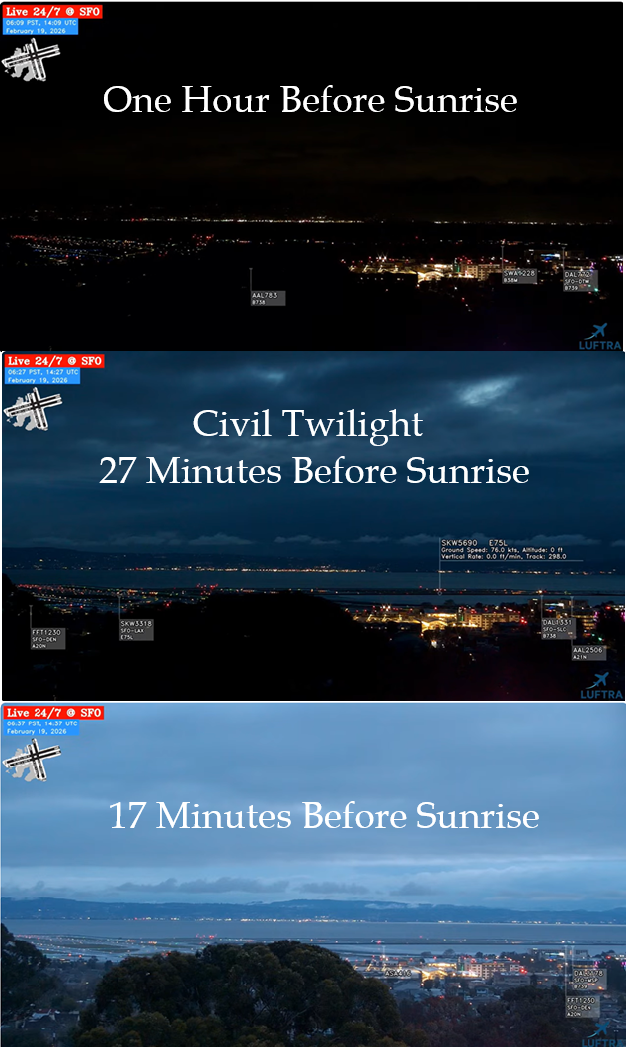
To illustrate this concept, we took screenshots from an SFO airport YouTube live stream on Feb. 19. Notice the drastic change as sunrise approaches.

Myth 2: Kids would have to walk to school in the dark under permanent DST
-
Only 13% of kids currently walk/bike to school (down from 48% in 1969) as parental chauffeuring has skyrocketed
-
Only ~5% of kids would walk to school in the dark (before Civil Twilight begins) under permanent DST
-
49 states start school (on average) after Civil Twilight begins during the current Standard Time period in the winter
-
84% of K-12 students in America would start school after Civil Twilight begins (calculated using population-weighted data)
Myth 3: It won't be light until 9am in a significant part of the country
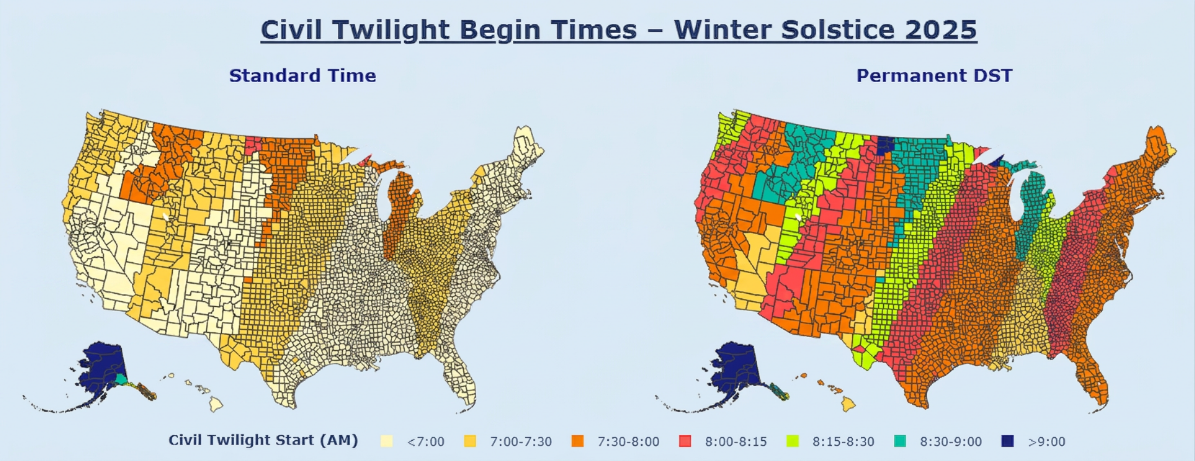
We created the map below to show Civil Twilight start times across the country under permanent DST on the shortest day of the year, winter solstice.
-
Only 4% of the US population lives in an area where Civil Twilight would start after 8:30am
-
Only 15% of the US population lives in an area where Civil Twilight would start after 8:15am
-
67% of the US population lives in an area where Civil Twilight would start before 8:00am
-
Edge cases where there isn't usable light until after 9am are exceptionally rare
Our Interactive County-Level Map and Zip Code Tool show Civil Twilight start times, Sunrise times, and Sunset times across the country.
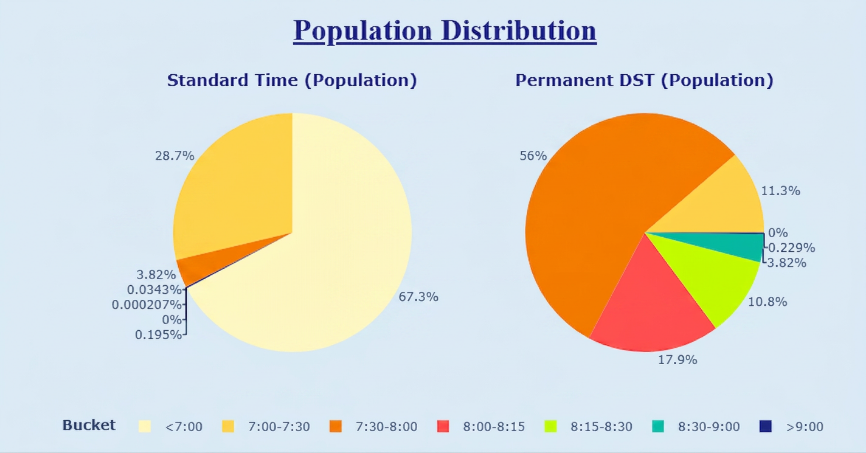
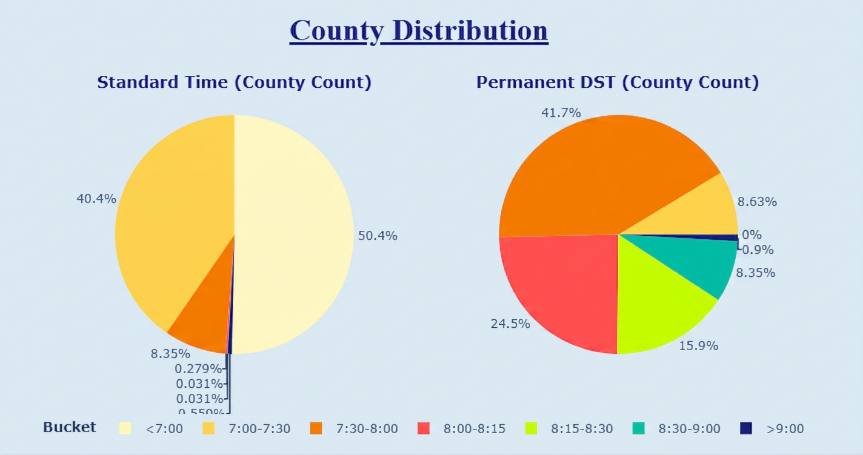
Who actually wakes up before it's light?
Population distribution of Americans by what time Civil Twilight begins where they live, under Standard Time vs. Permanent DST. Even under Permanent DST, ~96% of the population still sees light before 8:30 AM
Myth 4: Permanent DST was tried in 1974 and failed. Why try again?
Reality: It didn't fail on the data; it was torpedoed by a media-driven moral panic during a world that looks nothing like today.
The Morning "Accident Spike" That Wasn’t
In January 1974, the U.S. switched to year-round DST to save energy. Headlines immediately screamed about a "Daylight Disaster" involving schoolchildren in the dark.
-
The Florida Stat: Much was made of eight schoolchildren killed in early-morning car crashes.
-
The National Truth: According to the National Safety Council, total pre-sunrise school-age fatalities nationwide rose from 19 to 20 between January 1973 and January 1974 ("no notable increase").
-
The Reality: That is a difference of one death across the entire United States. While every tragedy matters, a national policy was repealed based on a statistical ripple.
What the Headlines Ignored
While the mornings were darker, the afternoons were significantly safer. Because more people drove home in the daylight, the overall safety impact was positive:
-
Net Reductions: an Insurance Institute for Highway Safety study noted that there is significantly more traffic volume (both cars and pedestrians) during the evening commute than during the morning commute, and permanent DST would have saved 180 fatal crashes per year.
-
A Second Study: Coate and Markowitz found that full-year DST would reduce pedestrian fatalities by 171 per year, roughly 13%, and motor vehicle occupant fatalities by 195 per year, or 3%.
1974 vs. Today: Why the Comparison Fails
If you are worried about morning darkness, remember that 1974 was a different era of technology and infrastructure:
-
The School Commute: In 1974, walking alone was the default. Today, most kids are driven or ride modern buses.
-
Visibility: In 1974, cars used tungsten incandescent sealed-beam headlights, the same basic design in use since the 1940s. Halogen sealed beams weren't federally permitted in the US until the late 1970s. Today's LED and HID headlights throw far more light, farther down the road, and illuminate the roadside where kids stand.
-
Stopping Power: 1974 cars had primitive brakes that locked up and skidded in the dark. Modern Anti-lock Braking Systems (ABS) and automatic emergency braking can prevent a collision before it happens.
-
Infrastructure: We have moved from sparse, orange-tinted streetlights to high-contrast LED grid lighting and high-visibility crosswalks.
The Real Killer: The "Switch"
We no longer have to guess about the risks. Decades of modern research show that the biannual "Spring Forward" is the actual danger:
-
Fatal traffic accidents jump by 6% in the week following the time change.
-
The disruption causes a measurable increase in heart attacks and workplace injuries.
-
Studies suggest that the Monday following spring DST clock changes result in lower stock market returns and increased volatility due to sleep deprivation.
Myth 5: Permanent DST throws our bodies out of sync with the sun, robbing us of 19 minutes of sleep every night
The 19-minute figure comes from a study done by Giuntella and Mazzonna (2019). It only looked at adults with jobs. But 41% of Americans aged 16 and over are not employed. The study did not examine those people.
The study covers 2003 through 2013. That is before the pandemic, before remote work became common, and before gig work like Uber and DoorDash became ubiquitous. The share of Americans working from home at least one day per week increased from 24% before the pandemic, to 35% today according to the Bureau of Labor Statistics.
Myth 6: We need the morning sun to wake up naturally
The idea that Americans wake up "with the sun" is a romanticized myth. Data from the U.S. Bureau of Labor Statistics and Edison Research reveals that the vast majority of the population is already disconnected from the sun’s schedule.
-
The "Sunrise Window": We define "waking with the sun" as the one-hour window between the start of civil twilight (when the sky begins to brighten) and about 15 minutes after the sun actually clears the horizon.
-
The Reality Gap: During winter under our current system, approximately 40% of Americans wake up in the dark . ~40% wake up in broad daylight. Only ~20% of the population actually wakes up with the sun.
-
The Alarm Clock Era: We live in an era of alarm clocks, blackout curtains, and artificial indoor lighting. Our wake-up times are dictated by school bells and office hours, not the solar cycle.
Myth 7: Construction workers and farmers who start early would be hurt
This one sounds intuitive, but it dissolves under scrutiny. Outdoor workers whose jobs depend on daylight — farmers, construction crews, landscapers — already adjust their start times with the seasons. A crew doesn't break ground at 5:30am on a January morning regardless of what the clock says; they start when there's enough light to work safely. Their constraint is sunrise, not the time zone. Permanent DST doesn't move the sun.
Permanent DST doesn't create darkness, it redistributes it. December has roughly nine hours of daylight no matter what. The question is whether those hours fall 7am–4pm or 8am–5pm. Shifting to the latter means outdoor workers who did start early would simply adjust by an hour, the same adjustment they already make every spring.
Myth 8: Other countries tried PDST and reverted back
This claim leaves out crucial context. The best-known reversals involved daylight conditions far more extreme than those most Americans would experience. Russia abandoned permanent DST after winter sunrise reached roughly 10:00 a.m. in Moscow and even later farther north. Britain’s 1968–1971 experiment faced particularly strong opposition in Scotland, where midwinter sunrise approached 10:00 a.m. The population-weighted average winter sunrise in Russia and Britain is 68 and 40 minutes later than the US, respectively.
Brazil used ordinary seasonal DST and abolished the seasonal clock change in 2019 because the government concluded the energy-saving benefit had diminished. It never ran a modern experiment where it kept summer time through the winter and then rejected it. Chile did not switch to permanent Standard Time; it went back to seasonal DST. Its far-southern Magallanes region subsequently adopted permanent summer time and kept it.
Portugal is also sometimes cited, but it did not simply adopt U.S.-style permanent DST. From 1992–1996, it shifted into Central European Time while still observing summer time, putting its clocks one hour ahead in winter and two hours ahead in summer relative to its prior system. Portugal’s 1992–96 experiment produced population-weighted winter sunrises around 8:43 a.m., roughly half an hour later than the U.S. would average under permanent DST. Portugal was geographically poorly aligned with the Central European time zone it adopted.
Myth 9: Permanent Standard Time is more aligned with our schedules
In our opinion, Permanent Standard Time is the worst out of the three choices. It's also politically and practically unfeasible.
With Permanent Standard Time, the average sunrise through the year would be 6:06am (population- and time-weighted). With Permanent Daylight Saving Time, it would be 7:06am. A policy that gives us an extra hour of sunlight when most people are sleeping makes no sense and congress would never allow it to become law.